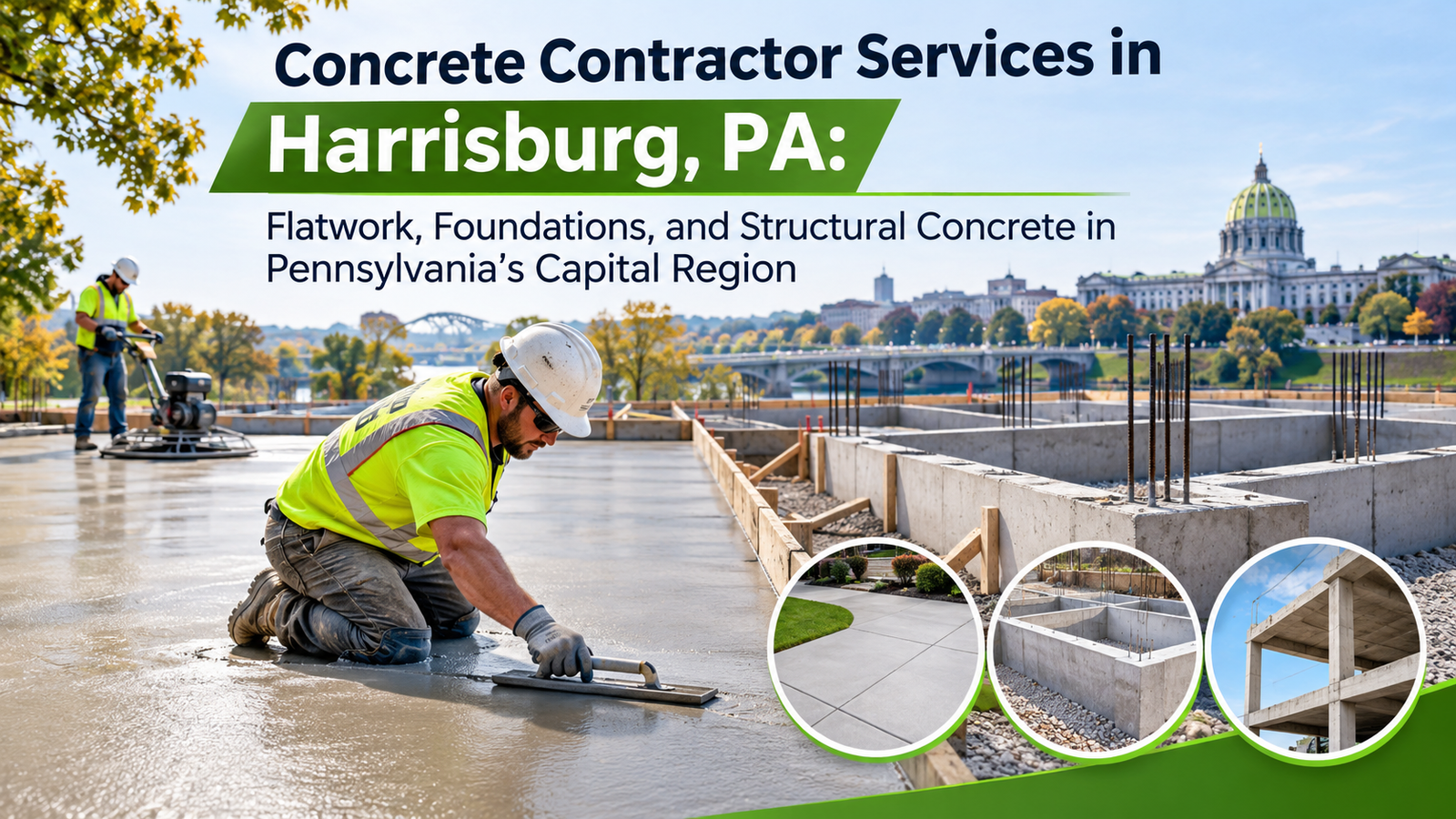
Harrisburg is Pennsylvania’s state capital and the center of the region’s government, healthcare, and business activity. The greater Harrisburg area including Dauphin County’s townships and the boroughs along the Susquehanna River is a diverse built environment ranging from the dense downtown and Midtown residential fabric of the city itself to the growing suburbs of Swatara, Lower Paxton, and Susquehanna townships. Concrete construction and concrete repair are constant activities across this landscape: driveways being replaced in the city’s older residential neighborhoods, parking lots being expanded or repaired at the region’s commercial centers, and structural concrete contractor Harrisburg work on the infrastructure and buildings that serve a metropolitan area of roughly 600,000 people.
Concrete Work in Harrisburg’s Residential Market
The city of Harrisburg has a large inventory of older housing much of it from the late nineteenth and early twentieth centuries in Midtown and Uptown, and from the mid-twentieth century in the South and West neighborhoods. Concrete work in this residential market is primarily replacement and repair of aging concrete flatwork: driveways, sidewalks, porch foundations, and steps. Harrisburg’s winters are demanding for concrete, with freeze-thaw cycles that cause spalling (surface layer flaking from freeze-thaw pressure in the concrete’s surface pores) and cracking in older concrete that may have been placed before modern air entrainment became standard practice.
Air entrainment intentionally introducing microscopic air bubbles into concrete mix is the primary defense against freeze-thaw damage in concrete. The air voids provide space for water in the concrete’s pore system to expand when it freezes, preventing the internal pressure that causes spalling. Modern concrete specifications for exterior flatwork in Pennsylvania mandate minimum air content (typically 5 to 7 percent for severe freeze-thaw exposure), and concrete placed without adequate air entrainment typically shows surface scaling and spalling within a few years of placement in Harrisburg’s climate.
Harrisburg’s older concrete sidewalks and driveways some of them original to early twentieth century development are increasingly at the end of their service life. The city’s sidewalk repair program and the requirements imposed on property owners to maintain the sidewalk adjacent to their property drive significant sidewalk replacement work in the city’s older neighborhoods. Curb ramp upgrades to current ADA standards are an ongoing activity in Harrisburg as the city’s street improvement program brings its pedestrian infrastructure into compliance with modern accessibility requirements.
Pennsylvania’s Concrete Specifications and Standards
Concrete construction in Pennsylvania is governed by the Pennsylvania Uniform Construction Code (UCC), which adopts the International Building Code (IBC) with Pennsylvania amendments, and by PennDOT’s Publication 408 for public works construction. The IBC and ACI (American Concrete Institute) standards within it specify minimum concrete compressive strengths, reinforcement requirements, and construction practices for different applications. For residential flatwork in Harrisburg’s freeze-thaw climate, the typical minimum compressive strength is 3,500 to 4,000 psi at 28 days, with a minimum air content of 6 percent for exterior exposed surfaces.
Harrisburg is in a seismic design category based on Pennsylvania’s seismic hazard maps, though the region’s seismic hazard is considerably lower than California. Structural concrete in Harrisburg must comply with the IBC’s seismic provisions for the applicable design category, which affects reinforcement detailing for foundations, walls, and columns. The practical impact on most residential flatwork is minimal, but commercial and institutional construction in Harrisburg requires seismic design by licensed structural engineers.
The Harrisburg area’s construction permit process operates through individual municipalities the City of Harrisburg Building Department, Dauphin County municipal building code offices, or third-party inspection agencies that serve smaller municipalities. Building permits are required for new concrete foundations, retaining walls above specified height thresholds, and significant new flatwork that changes impervious surface coverage. Routine replacement of existing driveways and sidewalks often does not require a permit, but property owners should verify with the applicable local code office.
Concrete Flatwork in Pennsylvania’s Winter Climate
Hot weather concreting dealing with rapid evaporation and accelerated set in summer heat is a less significant issue in Harrisburg than in warmer climates, though summer concrete work in Pennsylvania still requires attention to evaporation control in hot, dry conditions. The more significant climate challenge in Harrisburg is the winter and transitional season: cold weather concreting when temperatures approach or fall below the thresholds for safe concrete placement, and the freeze-thaw exposure that newly placed concrete faces in its first winter.
ACI 306, Cold Weather Concreting, provides guidance for concrete work when ambient temperatures fall below 40°F. Fresh concrete must be maintained above a minimum temperature (typically 50°F for ordinary concrete) during the curing period to develop adequate strength before freeze-thaw exposure. This requires temperature monitoring, insulating blankets, heated enclosures, or some combination of these measures when paving in cold conditions. Concrete that freezes before reaching the minimum strength for freeze-thaw resistance can be permanently damaged and must be removed and replaced.
The concrete should not be placed on frozen ground a frozen subgrade acts like ice under the slab, and when it thaws, the slab settles unevenly. Spring concrete work in Harrisburg must verify that the frost has fully left the subgrade before placing flatwork. Harrisburg’s frost penetration depth typically 24 to 30 inches means that spring work can begin as early as late March in mild years or may need to wait until April in cold years.
Reinforced Concrete and Foundations in the Harrisburg Region
Structural concrete in the Harrisburg area foundations, retaining walls, and structural slabs requires engineering design and licensed inspection in most cases. The Pennsylvania UCC mandates that construction documents for structural elements be prepared and stamped by a licensed professional engineer or registered design professional. Inspections of reinforcement before concrete placement, and testing of concrete at the time of placement (slump, air content, temperature, and test cylinders for strength verification), are required for most structural work.
The Susquehanna River floodplain extends through Harrisburg, and properties within the FEMA-designated Special Flood Hazard Area have additional requirements for flood-resistant construction, including minimum finished floor elevations and flood-proofing measures for structures below the base flood elevation. Concrete foundations and slabs in the floodplain must be designed to withstand flood loads and must use flood-resistant materials.
Frequently Asked Questions: Concrete Contractor in Harrisburg, PA
What is air entrainment and why is it required for concrete in Pennsylvania?
Air entrainment is the intentional introduction of microscopic air bubbles into concrete mix during batching. The air bubbles create a network of tiny voids in the hardened concrete that provide space for the water in the concrete’s pore system to expand when it freezes, preventing the internal pressure that causes surface spalling and scaling. Pennsylvania concrete specifications require minimum air content of 5 to 7 percent for exterior concrete exposed to freezing and thawing. Concrete placed without adequate air entrainment in Pennsylvania’s climate typically shows surface damage spalling and scaling within a few freeze-thaw seasons.
How does Harrisburg’s frost depth affect concrete flatwork?
Harrisburg’s frost penetration depth the depth to which the ground freezes during cold winters is approximately 24 to 30 inches. This affects concrete flatwork in two ways: concrete should not be placed on frozen ground (the thawing subgrade causes uneven settlement), and exterior concrete placed in fall or early spring may be exposed to freeze-thaw cycles in its first winter before it has fully developed its strength and durability. Cold weather concreting practices maintaining adequate concrete temperature during curing protect freshly placed concrete from premature freeze-thaw damage.
What permits are required for a new concrete driveway or sidewalk in Harrisburg?
Permit requirements vary by specific location and project scope within the greater Harrisburg area. In the City of Harrisburg, routine replacement of an existing driveway or sidewalk in kind typically does not require a building permit, but creating a new driveway access or significantly expanding impervious surface area may require a permit and stormwater review. Work on a sidewalk adjacent to public right-of-way may also require a permit from the City’s Bureau of Highways. Property owners should contact the applicable municipal code office to verify requirements for their specific project before work begins.
What is the flood risk consideration for concrete work in the Harrisburg area?
Harrisburg straddles the Susquehanna River, and significant portions of the city and adjacent townships are in FEMA-designated Special Flood Hazard Areas (100-year floodplain). Properties in these areas have requirements for flood-resistant construction, including minimum finished floor elevations, use of flood-resistant materials (concrete qualifies), and in some cases elevation of mechanical systems. Concrete foundations and slabs in the floodplain must be designed for flood loads. Flood zone determination for a specific Harrisburg property can be verified through FEMA’s Flood Map Service Center or the applicable municipal floodplain administrator.